|
||
|
Home
Friends of the
AMERICAN UNIVERSITY OF AFGHANISTAN
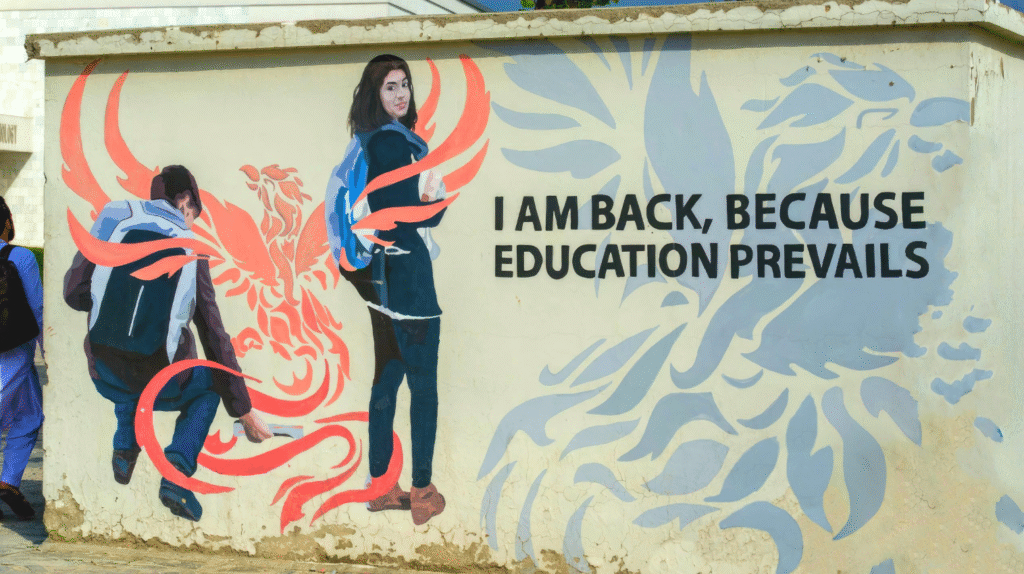
Education Will Prevail
Ushering in a New Era
Today, the American University of Afghanistan (AUAF) remains a beacon of hope for a new generation of young Afghans who wrestle with a new set of political and social realities yet remain ambitious and fervent to lead change in their own country and society.
Three Tiers to Success
AUAF’s adaptive and innovative online education prepares, fosters, and advances thousands of Afghan students; a generation of young Afghan leaders determined to lead change within their country.
Tier 1
Prepare
Afghanistan is the only country in the world today that officially restricts access to education for women above the 6th grade. AUAF expanded its preparatory programs to bridge the growing divide between secondary and higher education, and reposition young Afghans back on their educational journey.
Tier 2
Foster
AUAF’s high-touch, high-quality American-style education fosters an environment conducive to leadership, agency, civic ideals, and economic advancement. Students are equipped with the knowledge and skills to define their individual and collective futures through a holistic education, including wrap-around services, such as wellness programs and extracurricular activities.
Tier 3
Advance
AUAF supports its graduates in achieving success across academic, private, and public sectors, providing guidance and resources as they advance in their careers and contribute to their fields.
Reflections from Dr. Diana Sedney – Girls in STEM Day
Letter from AUAF President Dr. Ian Bickford
Dear Friends,
I write to you with reflections on a year during which your extraordinary support has given a fresh new beginning to a university mission without parallel. Afghanistan remains the only country in the world where half of the population is expressly banned from education. The American University of Afghanistan remains the only university expressly dedicated to restoring that right while upholding education as foundational to any possible peace, security, and justice. We are grateful to the U.S. Department of State for continuing to support this work. And in a time of profound upheaval, we could not succeed without each of you in our greater community.
More than four years ago, AUAF made the bold decision to continue our mission after the fall of Kabul, and our students made the brave decision to continue their pursuit of education despite extreme uncertainty and risk. Those decisions, along with monumental generosity from so many of you, brought us to where we are today: entering our 20th year with more students enrolled than ever, including more women than ever, and greater confidence than ever in the impact and potential of our educational model.
What gives us confidence? You may reasonably worry that Afghanistan has been largely forgotten in much of the world, as other severe crises have dominated public discourse and international aid. Security in Afghanistan is fragile, diplomacy has made no progress, and life for most Afghans has not improved – in fact, for many it has worsened. Yet as one of my colleagues wrote to me recently,
پشت هر تاریکی، روشنی است
After every darkness, there is a light.
Most languages and cultures share this sentiment – enough that we might call it a universal theme. Our students often refer to their education at AUAF as “the light of hope.” As they recognize, we cannot passively wait in darkness for the dawn. We must do our part to ignite it.
We see it ignited in the many collaborations and partnerships that have coalesced around a shared mission and purpose. We also see it in something new that is happening. Instead of viewing Afghanistan in isolation, our partners today understand the complex intersection of our world’s many crises and the global scale of the challenges humanity faces.
This is why I am especially proud to announce the launch of the Bard Global Degree, bringing together disenfranchised students and faculty from numerous places in conflict and crisis, including Afghanistan, Myanmar, Russia, Ukraine, and South Sudan through a single, shared degree program with Bard College in New York State. AUAF’s first Global Degree cohort represents the vanguard of an entirely new way of imagining education for those to whom it has been denied.
In addition:
AUAF’s new offices at Georgetown University-Qatar now embed our efforts within the most visible and celebrated international studies program in the Middle East.
We have begun a new collaboration with BoodleBox, a collaborative platform designed for higher education and embracing purposeful, faculty-driven uses of AI for the very specific needs of Afghan students.
And our friends at Duolingo, a language learning platform, now enable us to assess more than 20,000 new applications each year.
That last number is no exaggeration and tells us everything about the demand for an AUAF education in Afghanistan. It is why we refuse to settle for the current situation, when we are able to enroll only 200 new students each year, all receiving 100% financial aid. Therefore, we pledge in 2026 to introduce new, affordable, high-tech certificate programs capable of reaching many thousands, building skills for employment, and generating capacity for Afghanistan’s workforce.
These are the opportunities to ignite “the light of hope.” It is true that our graduates face a more confounding employment environment than most in the world. Yet so many are successful after graduation because AUAF develops their ability to handle complexity, communicate effectively, and innovate their own opportunities. In Afghanistan, the quality of education they receive at AUAF is not a luxury. It is more than ever before a necessity.
AUAF’s liberal arts degree programs and high-tech training programs change lives and can change the world our students inhabit. Together, let’s make these programs available to all ambitious, talented, and hopeful young women and men in Afghanistan who see a future AUAF graduate in themselves.
With gratitude,
Ian Bickford
President
The American University of Afghanistan
“AUAF taught me that education survives because people choose to protect it, a truth I learned firsthand in 2016. As a graduate, I remain committed to that shared responsibility to keep education alive.”
Anil Qasemi
Co-chair of AUAF Alumni Consortium
Our Champions, Thank You
Our Champions – Thank you
Whether you have stood with us for many years, rejoined us after some time away, or experienced our mission for the first time at the 15th Annual Awards Dinner—thank you for showing up, standing with us, and being a champion for the young people of Afghanistan.
The evening was filled with meaningful connections and shared purpose. We heard stories from our outstanding graduates and students, and together, we witnessed a resounding commitment to AUAF’s mission and a renewed belief in what is possible for Afghanistan’s next generation of leaders.
You are our champions.
Thank you for your presence, your generosity, and your commitment.
Below are a few moments from the evening — we hope they bring back the warmth and inspiration we all felt.
With gratitude,
American University of Afghanistan
In Memorian: Razia Jan
With deep sorrow, we share the news of the passing of Razia Jan, an Afghan American activist who championed girls’ right to education. She passed away on July 20 at her home in Los Angeles, according to The New York Times.
After the U.S. military engagement in Afghanistan, Razia returned to her homeland, first bringing supplies to orphanages and hospitals, and soon dedicating her life to ensuring Afghan girls could learn. In 2008, she founded the Zabuli Education Center through the Razia’s Ray of Hope Foundation, which today continues to serve more than 800 girls. She later established the Razia Jan Institute to train young women in midwifery and other vital skills.
Razia’s legacy lives on in the thousands of Afghan girls whose lives she transformed through education.
August in AUAF: A Month of Remembrance
On August 24, 2016, the American University of Afghanistan suffered a devastating, complex terrorist attack on the second day of school.We honor the memory of those whose lives were lost that day and recognize the lasting impact on every survivor, family member, teacher, student, and friend.
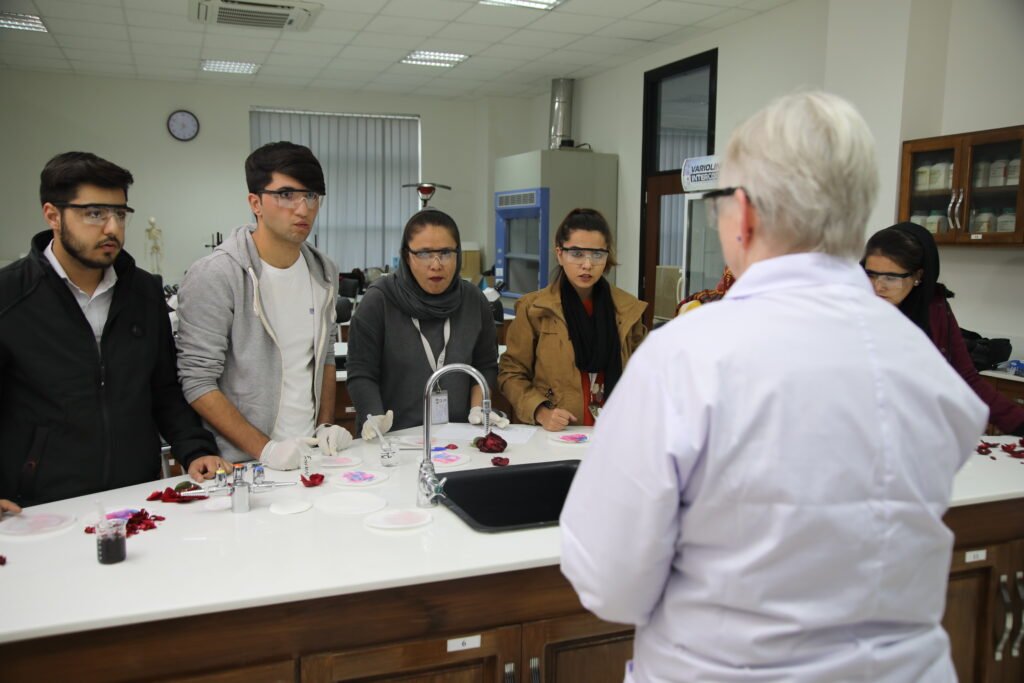
Their courage, dreams, and spirit remain a part of AUAF’s story, and a reminder of why our mission matters.
We remember:
Mohammad Alem
Mohammad Akbar Andarabi
Ahmad Mujtaba Exeer
Einaz Haidery
Jamilla Ismailzada
Fazel Khaliq
Naqeeb Khpalwak
Sayed Rasool
Samiullah Sarwari
Waisodin
Abdul Wakil
Ahmad Jamshid Zafar
Zubair Zakir

On August 15, 2021, the Afghan government collapsed.
It marked the beginning of another chapter of uncertainty, upheaval, and displacement for AUAF. Students, faculty, and staff faced a dangerous reality.
Yet even in the midst of loss and separation, AUAF’s mission did not stop. Two weeks later, the fall semester started on-time due to the innovative online teaching developed during the COVID-19 pandemic and the determination of our students to learn. Hope endured despite the darkness.

These moments could have ended our mission.
Instead, they deepened our resolve.
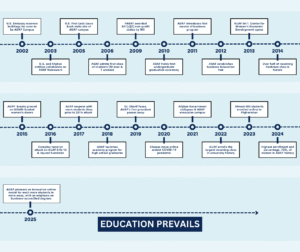
Time and time again, AUAF comes back stronger, adapting and innovating to ensure our mission continues. Today, we share our updated AUAF Timeline, a living record of our challenges, our milestones, and our continued belief that education can bring our students a brighter, more prosperous future.

Bush Institute Executive Director David J. Kramer Speaks at 2025 U.S.–Afghan Women’s Council Annual Meeting
“At the Bush Institute, we refuse to give up on Afghanistan… We remain committed to a brighter future for all Afghans.”
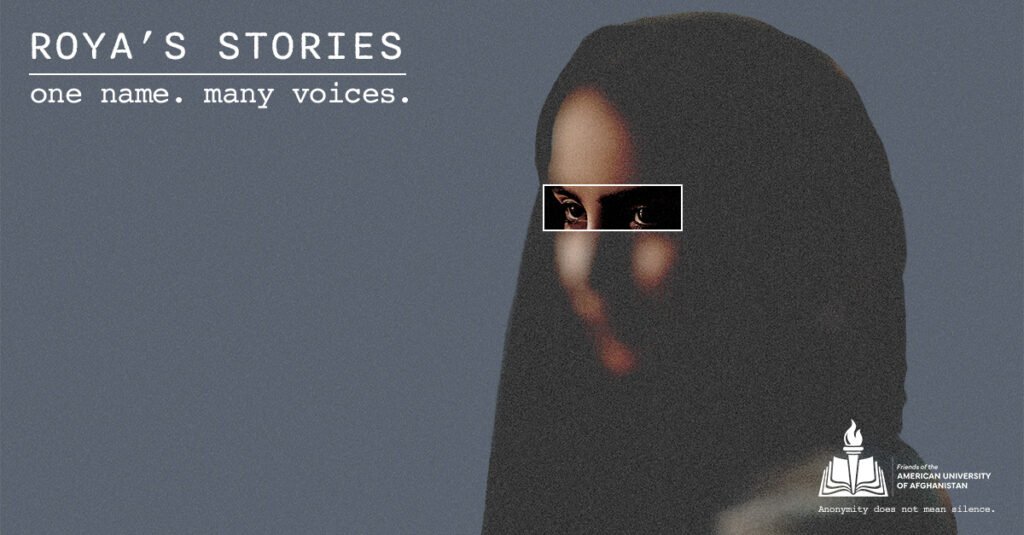
Introducing Student Spotlight Series: Roya’s Stories, One Name, Many Voices
In Afghanistan today, women are banned from higher education. Speaking out about your beliefs can be dangerous. For many AUAF students, staying safe means staying anonymous.
But anonymity does not mean silence.
Throughout history, writers have used pseudonyms to speak truth in hostile environments. For our students—who can’t safely use their own names—we’ve chosen one: Roya, which means dream in Dari.
Roya is not one person. Roya is every student who carries their courage in secret.
Each story in this series will be shared under that name.
Roya’s Story #1: A Dream I Never Let Go
I first heard about AUAF when I was a high school student. It became my biggest dream to study there, to walk the campus, to be part of something bigger. At the time, I was admitted to Kabul University, and for many reasons, I couldn’t make the switch. But the dream never left me.
Years later, when the world seemed darker and education for women felt almost impossible, I got the chance. I joined AUAF. And I am still here, studying—despite everything.
The experience has changed my life. It’s not just about learning. It’s about hope, resilience, and proving that we still exist——we who believe in a future worth fighting for.
Even without a physical classroom, even with electricity outages, even when it feels overwhelming to juggle so much from home—I keep going. Because this chance is rare. And I know what it means.
Since 2018 I have collaborated and volunteered with several organizations to promote education and leadership for youth and girls in my community. I founded a non-profit, where we train young women in leadership and peace building. I’ve met people from Italy, Nigeria, and France through our workshops. Some of the girls I’ve trained are now leading efforts in their own communities.
I want the world to know that Afghan women are resilient. We are leaders. We just need a chance to show it.
I don’t want to be limited to one degree or one role. I want to become a software engineer and a journalist. I want to explore the world and bring opportunity back with me. I want to live a life of meaning and help others do the same.
— Roya
Support more voices like Roya’s
Your gift helps AUAF continue to educate courageous students who are changing their communities—and the future of Afghanistan.
Congratulations Class of 2025!
Class of 2025, you did it!
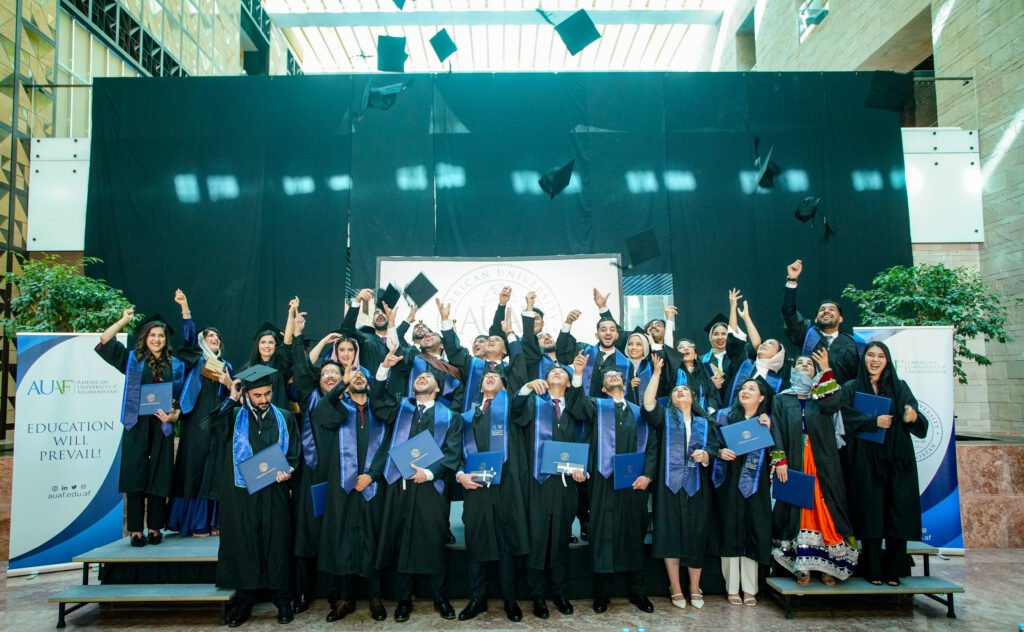
This June, AUAF honored the achievements of its graduates in two powerful ceremonies that celebrated both academic excellence and the worldwide support behind their journey.
On June 18, 33 students from the Doha campus crossed the stage at Carnegie Mellon University Qatar, joined by esteemed guests from the Qatar Foundation, Friends of AUAF, and international missions. AUAF President Dr. Ian Bickford urged them to “show the world why AUAF matters,” while Friends of AUAF founder Leslie Schweitzer encouraged them to lead with courage and responsibility.
Just days later, on June 28, the celebration continued with a virtual commencement for 102 graduates—connecting students, families, faculty, and alumni around the world. Guest speaker Farkhunda Muhtaj, Afghan footballer and social activist, praised the students’ resilience and determination to rise above every challenge.
Together, these moments reflect the strength, heart, and hope of AUAF’s global community.
“I learned not in comfort, but in crisis. The agony of this journey was mine, but the future it creates is ours. From every obstacle, we build a path where learning leads the way to a world imagined, and a future reclaimed.” -2025 AUAF Graduate
“To the American University of Afghanistan, thank your for being a symbol of hope…You are not just educating students,
you are preserving the future of a nation.” – 2025 AUAF Graduate
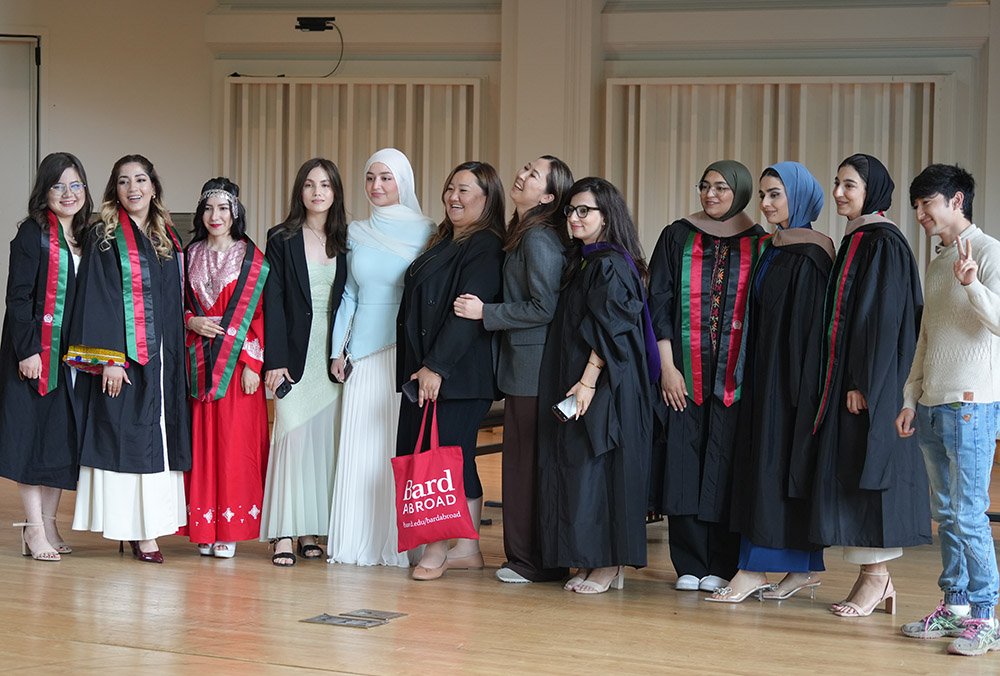
Displaced Students Honored at Bard College Commencement
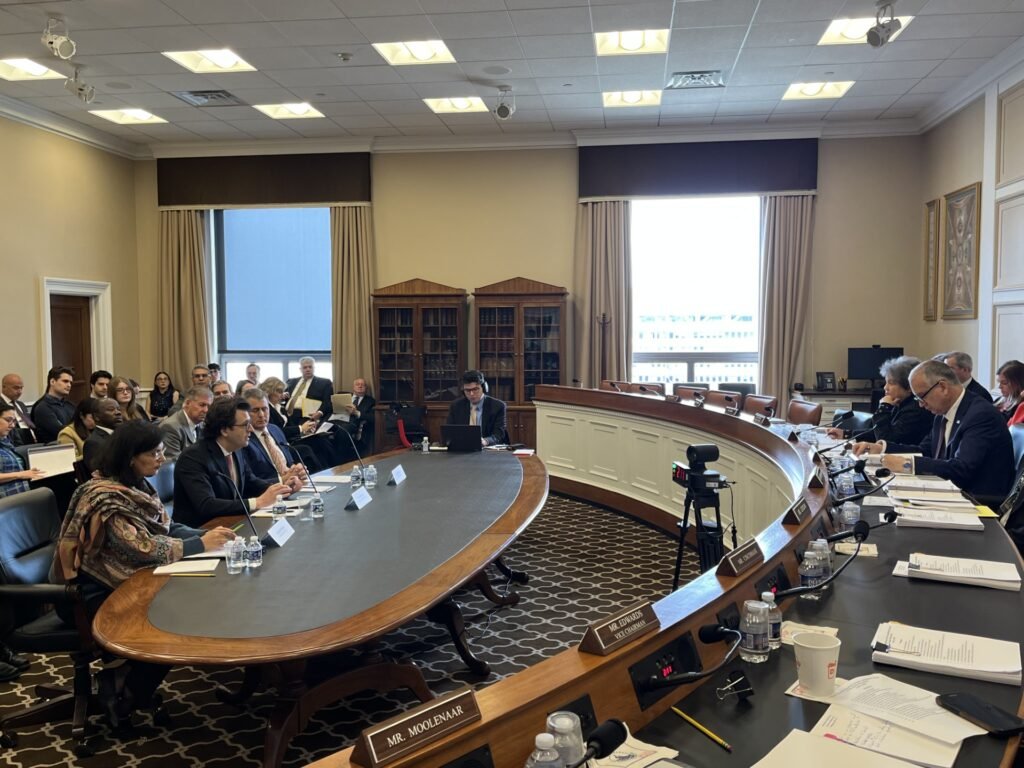
AUAF President Ian Bickford Testifies on Capitol Hill in Support of University Funding
On April 2nd, 2025, Dr. Ian Bickford, President of the American University of Afghanistan (AUAF), was invited to deliver testimony before the U.S. House Appropriations Subcommittee on State, Foreign Operations, and Related Programs, chaired by Representatives Mario Diaz-Balart and Lois Frankel. The hearing was an opportunity for AUAF to articulate its importance and advocate on behalf of Afghan students who remain ambitious to continue their education.
Dr. Bickford was joined by Breshna Musazai, an AUAF alumna and survivor of the 2016 terrorist attack on the university’s Kabul campus. Her presence underscored the resilience of AUAF’s students and the high stakes of ensuring the university’s survival.
See below to watch and read the full testimony.
Time stamp: 44:39
Nowruz Mubarak – Exciting News for AUAF!
A Letter from Leslie M. Schweitzer – Founder & Chair, Friends of AUAF
Dear Friends and Supporters of AUAF,
We are pleased to share encouraging news: thanks to extensive outreach, advocacy, and steadfast support from our broader community—including many dedicated donors such as you— after a brief pause, U.S. Government (USAID) funding has been restored so that AUAF can resume it’s spring semester immediately. This critical development brings students back to class after Nowruz—a meaningful celebration symbolizing renewal and new beginnings.
Restoration of funding provides crucial short-term relief, but significant work remains to secure AUAF’s long-term sustainability. The University must accelerate efforts to restructure, innovate, and fund programs for high school girls as well as co-ed undergraduate and graduate programs in-country. Your continued generosity remains vital as AUAF builds toward this future.
Currently, we are close to completing a matching challenge—doubling a generous donor’s $250,000 gift to $500,000. Every contribution brings AUAF closer to this goal and strengthens its capacity to navigate the future and continue our vital mission.
Education remains vital to Afghanistan’s future. AUAF graduates are the next generation of leaders who drive prosperity and disrupt cycles of radicalization within their villages, communities, and homes. In many ways, an AUAF education goes beyond its recipient.
Your generosity enables AUAF to continue to provide life-changing world-class education, to innovate programs to reach more students in more ways, and to endure as the only institutional American legacy remaining in Afghanistan.
Sincerely,

___________
In Afghanistan, Nowruz is especially meaningful. The Guli Surkh Festival (Festival of Red Flowers) in Mazar-i-Sharif marks the occasion, as vibrant red tulips bloom across the fields—a symbol of hope and resilience, much like AUAF’s students who continue their education against all odds.
Just as Nowruz ushers in a fresh start, the reopening of AUAF represents a new chapter of opportunity for our students. Their education—temporarily out of reach—is now back in their hands.
Thank you for being part of this moment.
While this funding provides immediate relief, we must continue working toward long-term sustainability for AUAF.
FAUAF Attends “Guerrera” Discussion at the Military Women’s Memorial
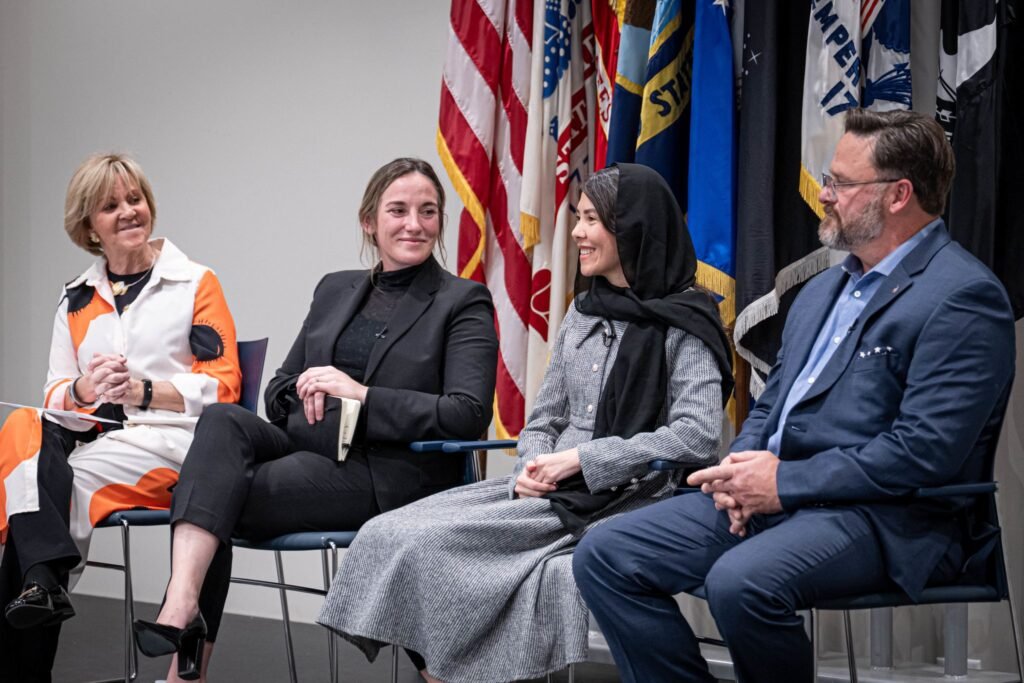
The Friends of the American University of Afghanistan (FAUAF) had the honor of attending a powerful event hosted by the Women, Peace, and Security initiative at the Military Women’s Memorial in Arlington, Virginia. The evening centered on an exclusive discussion of Guerrera, a forthcoming documentary series that sheds light on the courageous women who served on the frontlines of America’s longest war.
Produced by Jessica Yahn in partnership with AllTru, Dulcinea Productions, and the Atlantic Council’s Counterterrorism Project, Guerrera explores the untold stories of the Cultural Support Teams (CST) and Female Tactical Platoons (FTP)—trailblazing women embedded within special operations units in Afghanistan. These units played a critical and often unrecognized role in counterterrorism efforts, bridging cultural gaps, gathering intelligence, and connecting with Afghan women in ways that male soldiers simply couldn’t.
The event featured a panel discussion with Yahn and members of the special operations and counterterrorism community, highlighting the importance of telling these stories—not just to honor the women who served, but to inform future strategies in global security and peacebuilding. Guests also viewed unreleased footage from the series and explored a new exhibit honoring women in Special Operations Forces (SOF).
For FAUAF, this conversation hit close to home. Many of the CST and FTP teams worked closely with Afghan communities, especially women and girls—building the trust that made education and development work possible. Their legacy is deeply intertwined with AUAF’s mission and the progress made over two decades in Afghanistan.
We’re grateful to have been part of this moving tribute and look forward to supporting future efforts that uplift the stories of women shaping history—both in combat and in classrooms.
AUAF Participates in ISOA Qatar 2025 Conference
Earlier this month, the International Stability Operations Association (ISOA) hosted its annual conference in Doha, Qatar—bringing together leaders in business, government, and development to explore strategic partnerships and the evolving landscape of the Middle East. The event focused on building shared futures between the U.S. and Qatar, with panels on regional dynamics, humanitarian aid, and business opportunities.
Friends of the American University of Afghanistan (FAUAF) was honored to participate in the conference. Leslie Schweitzer, FAUAF Founder and President, also serves on ISOA’s Advisory Council and played a central role in organizing the conference alongside ISOA and partner institutions in Qatar.
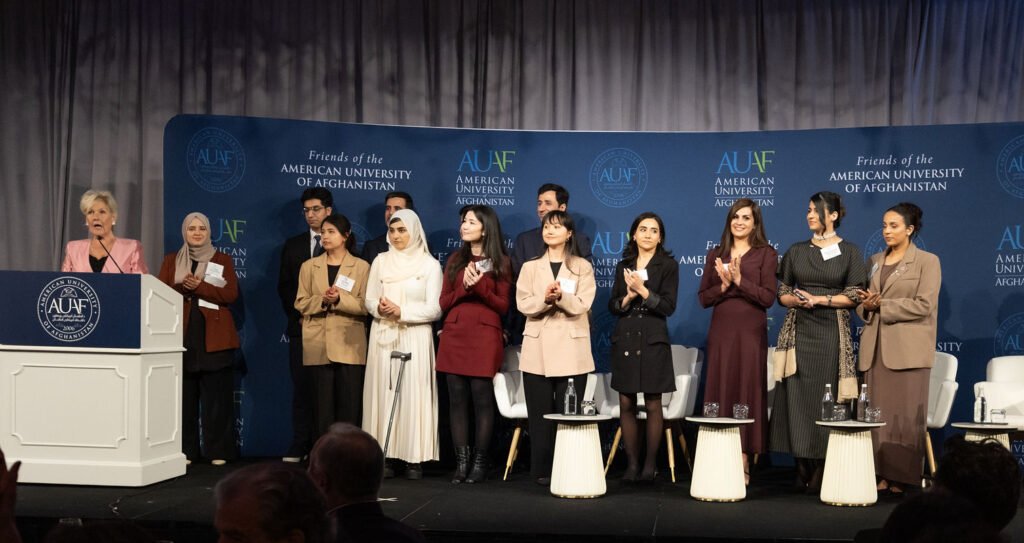
As part of the conference, AUAF hosted a booth staffed by student volunteers from our Doha campus. They proudly shared informational materials, university highlights, and personal stories with conference attendees. The booth provided a meaningful way to connect with ISOA members, potential partners, and supporters interested in AUAF’s mission of education and resilience.
Following the conference, ISOA members visited AUAF’s Qatar campus, where they had the opportunity to tour facilities, meet faculty and students, and even attend a few student-led activities—including friendly volleyball matches from the AUAF men’s and women’s teams.
AUAF’s presence at ISOA Qatar 2025 offered an inspiring opportunity to highlight the strength and determination of our students and community, and to deepen relationships with international partners who share our commitment to educational access and global cooperation.
AUAF Student, Faisal Popalzai, wins Innovation Excellence Award at the Microsoft AI Tour
We are proud to spotlight Faisal Popalzai, founder of HAWKS.AI, who was honored with the AI Innovation Excellence Award at the Microsoft AI Tour in Qatar. His groundbreaking AI-powered solutions in cybersecurity not only secured 1st place at the Microsoft Hackathon, but also placed him alongside global giants like Qatar Airways and Vodafone, showcasing the impact of an AUAF education on the world stage.
AUAF is at the cutting edge of online education, equipping students with the tools and knowledge to thrive in a rapidly evolving world. This achievement is a testament to the resilience of education, which prevails even in the face of immense challenges. Education transforms lives, empowers individuals, and drives progress—not just for our students, but for communities and industries worldwide.
Anniversary of Tragic Attack on AUAF Campus
August 24, 2016, The AUAF community was the target of a senseless and tragic complex terrorist attack. As we observe this painful anniversary, we remember our 15 lost students and colleagues and extend our love and support to the survivors whose lives are still affected.
Those who perished were true champions of the values that unite us. They believed in education, equality, opportunity, and justice. We honor them as we practice these values each day and on this day most of all.
Let us cherish this community that has survived so much, emerging from tragedy to choose courage over fear. If we are distant from each other in geography, it means only that our voices now resonate from every continent: we are here, we will remember, and we will prevail.
Remembering the lives lost in the 2016 attack at theAmerican University of Afghanistan:
Mohammad Alem
Mohammad Akbar Andarabi
Ahmad Mujtaba Exeer
Hafizullah
Elnaz Haidery
Jamila Ismailzada
Abdul Walid Karimzada
Fazel Khaliq
Naqeeb Khpalwak
Sayed Rasool
Samiullah Sarwari
Waisodin
Abdul Wakil
Ahmad Jamshid Zafar
Zubair Zaki
How the American U. of Afghanistan is thriving as a college in exile
As the Taliban advanced into the Afghan capital of Kabul, the last remaining administrators at the American University of Afghanistan destroyed the computer servers, fearful that student and staff records could fall into the wrong hands.
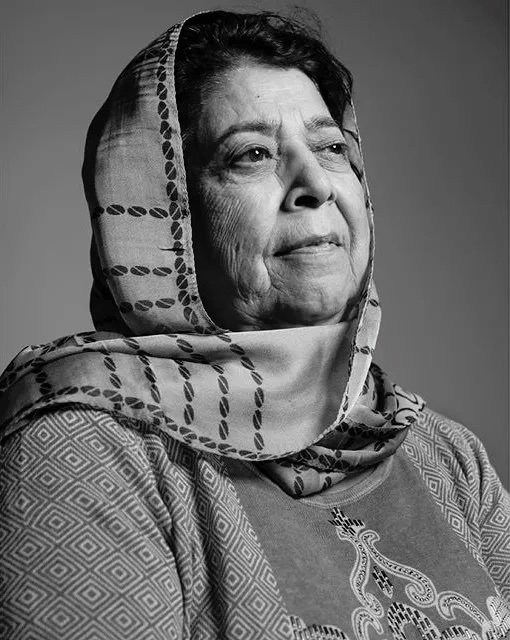
With the conservative Islamic group — which opposes education, especially of women and girls — in power again, the liberal-arts college, known as AUAF, became a university in exile.
But three years after the Taliban seized control of the Afghan government, on August 15, 2021, AUAF is, perhaps improbably, thriving. It now enrolls 1,100 students, the most since it opened, in 2006, online and at an interim campus in the Persian Gulf emirate of Qatar. Nearly 80 percent of the students it educates, in 20 countries, including Afghanistan, are women.
The persistence of the university, which was started by the U.S. and Afghan governments, is a testament to the power of education in the face of adversity and oppression, said Ian Bickford, AUAF’s president. “For our students, education is their lifeline.”
From the outset, amid American forces’ chaotic withdrawal, AUAF’s leaders were determined to keep the institution going — even if its physical campus was in Taliban hands. Within two weeks, the fall semester began, online and on time.
It was not an easy feat. Because the servers had been smashed, the college had no student files or class rolls, said Victoria Fontan, the provost. Officials had to recreate records, relying on professors to manually register their students in a spreadsheet.
Spread around the world, faculty members kept Kabul hours, teaching remotely from places like Oregon and Australia. Many students and local staffers remained in Afghanistan, unable to evacuate after the American pullout. Eventually, students were able to find passage out of the country in smaller groups, taken in by Qatar, the American University of Iraq Sulaimani, the American University of Central Asia, in Kyrgyzstan, and Bard College, the New York liberal-arts institution where Bickford previously taught.
Still, most students are online. At the time of the Taliban takeover, instruction at AUAF was remote because of the pandemic, a rarity in Afghanistan where nearly all schools and colleges had quickly resumed in-person instruction, Fontan said. Covid gave them a head-start in dealing with challenges such as poor internet connectivity and household demands on female students living at home.
AUAF also held classes online for seven months following a 2016 attack by militants that killed 13 students and employees.
And Bickford had the fortune — or misfortune — of being experienced at re-establishing learning at institutions that had been forced out of or expelled from their original homes. Bard helped Central European University move from Budapest to Vienna because of political pressure from Hungary’s nationalist government. Bickford was part of a group that set up a new university in Myanmar, which was then closed by a military coup.
A hunger for learning
Bickford went to Afghanistan in a deteriorating security situation in March 2021, knowing that AUAF might have to relocate. He immediately began talking with Qatar about the possibility of setting up a temporary campus in Education City, its foreign-college hub. “I had something of a tactile memory of the steps you might need to take if a university needs to go into exile,” he said.
Working with students who had experienced a shared trauma was especially difficult. For the first weeks after the Taliban takeover, students met in small faculty-led groups organized by major, talking about the events in the context of their fields of study. Fontan and her colleagues studied trauma-informed pedagogy in order to rethink instruction and provide training to the college’s 30 full-time faculty members and 75 adjunct professors. Institutions that had been through school shootings offered a guide, she said.
AUAF’s academic changes have been even more extensive. The college — which lost its Afghan accreditation when the Taliban took control and offers a dual degree with Bard — has restructured its graduate and undergraduate majors, overhauled general education, and innovated in online learning. “We are reinventing ourselves,” Fontan said.
Students can also study through the Open Society University Network, a consortium of colleges that offers shared online courses worldwide.
Both Fontan and Bickford said there was never any question about keeping AUAF going. Liberal-arts education is particularly important in authoritarian societies because it encourages agency and critical and independent thinking, Bickford said. “That’s not something that comes out of the blue. It comes out of learning.”
Despite the obstacles, young Afghans want education, and AUAF’s enrollment has increased. Last year the university started a transition program to help students prepare for college. In two days, it got 10,000 applications for just 350 spots. This year the program, which is also offered online, will expand to 1,000 students.
The college is also part of an alliance of colleges, nonprofit groups, and educational providers that works to expand access to education for Afghan girls and women.
“We owe it to them to be their hope,” Fontan said. “A hunger exists in Afghanistan for learning. And that is not going away.”
Mustafa Baktash Amiri
Jawad Bakhteiary
Fariha Safi
Samira Rezayee
Mursal Rasa
Hamida Qanbari
Zuhra Sultani
Zuhal Ahad
Khesrow Zaher
Mohammad Behroozian
Hameedullah Hassani
Beheshta Rasekh
Student Voices
Leslie Schweitzer, FAUAF Founder & Chair, sat down with AUAF students in Doha, Qatar to discuss the impact AUAF has had on their lives and the lives of those around them.